
Not all Japan eSIMs are created equal. Some give you blazing 5G speeds, others route your data through Singapore or London before it reaches Tokyo. Here’s why — and how to pick the right one.
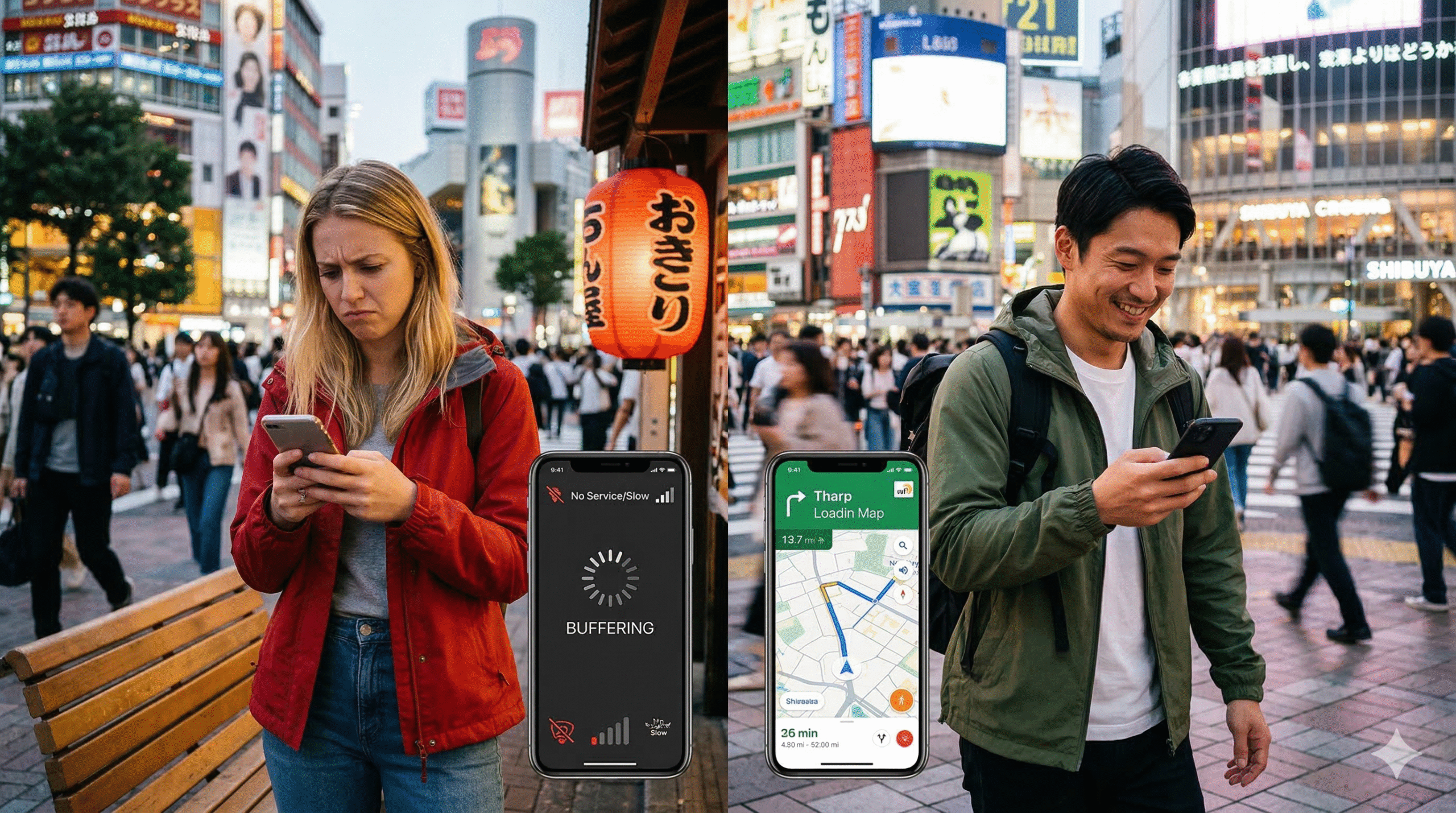
You’ve bought a Japan eSIM. You land at Narita or Kansai, switch it on, and… it’s slow. Google Maps takes forever to load. Instagram stories buffer. Video calls keep freezing.
You paid for “Japan data” — so why does it feel like you’re on a congested Malaysian highway during peak hour?
The answer isn’t your phone or Japan’s network. It’s how your eSIM routes your data — and most travel eSIM providers don’t tell you this part.
In this guide, we break down exactly why some Japan eSIMs are slower than others, what “local eSIM” actually means, how it’s different from typical travel eSIMs, and why it matters for Malaysian travellers heading to Japan.
Why Is My Japan eSIM So Slow?
If you’ve ever Googled “Japan eSIM slow” or “Airalo Japan speed”, you’ll find plenty of complaints. Travellers buy eSIMs expecting fast Japanese internet, only to get speeds worse than their home connection.
There are three main reasons this happens:
1. Your data may be routed through another country
Many travel eSIMs do not actually process your data inside Japan. Your phone may connect to a Japanese mobile network, but your internet traffic is often tunnelled back to a server in another country — such as Singapore, the UK, or parts of Europe — before reaching the wider internet. This can add 100–200ms of latency to every request.
2. You may be treated as a roaming user, not a local user
Japanese carriers generally prioritise their own local subscribers. When the network is congested — for example at Shibuya Crossing in the evening or during rush hour at Shinjuku Station — roaming users may receive lower priority. Even if your phone displays KDDI or SoftBank, it does not always mean you are getting the same priority level as a local customer.
3. Your eSIM provider may rely on a low-cost wholesale aggregator
The eSIM market often involves multiple middlemen. Many providers do not have direct agreements with Japanese carriers. Instead, they buy access through wholesale aggregators, who then work with the local networks. Each extra layer can mean slower routing, lower priority, and less control over overall connection quality.
How Japan eSIMs Actually Work (The Part Nobody Tells You)
To understand why speeds vary so much, you need to know what happens behind the scenes when your eSIM connects in Japan.
Japan has three major mobile carriers that own the actual towers and infrastructure: NTT Docomo, KDDI (au), and SoftBank. Every eSIM you buy — whether from Airalo, Holafly, Klook, Ubigi, or BuzzyBee — ultimately connects to one (or more) of these three networks.
But there’s a big difference in how they connect:
| Local eSIM (MVNO/Direct) | Travel eSIM (Roaming) | |
|---|---|---|
| eSIM profile issued by | A Japanese-registered operator or MVNO | A foreign operator (Singapore, UK, EU, etc.) |
| Data routing | Stays within Japan (local breakout) | Often routed through home country (home routing) |
| IP address | Japanese IP | May show Singapore, UK, or other country IP |
| Network priority | Treated as local subscriber | Lower priority (roaming user) |
| Latency | Low (under 50ms typically) | Higher (100–250ms due to routing detour) |
| Best for | Maps, video calls, streaming, real-time apps | Basic browsing if speed isn’t critical |
Think of it this way: a local eSIM is like having a Japanese phone number — your data goes straight to the internet from Japan. A travel eSIM using home routing is like sending a letter from Tokyo to Singapore, having it processed there, and then sending the reply back to Tokyo. Every webpage, every map tile, every WhatsApp message takes that detour.
Local Japan eSIM vs Travel eSIM: The Key Difference
Let’s make this crystal clear with a simple analogy.
Travel eSIM (roaming-based): Imagine you’re a Malaysian tourist walking into a Japanese restaurant. You can eat there, but you’re seated last, served after the regulars, and the kitchen processes your order through a translator in another country before cooking it.
Local Japan eSIM: You walk into the same restaurant, but this time you have a local membership card. You get the same seat, the same speed, the same priority as everyone else. Your order goes straight to the kitchen — no detour.
That’s the fundamental difference. A local Japan eSIM is registered on a Japanese carrier’s domestic network — typically as an MVNO (Mobile Virtual Network Operator). An MVNO doesn’t own the towers, but it has a direct commercial agreement with a carrier like KDDI or Docomo to use their network as a local entity.
Most budget travel eSIM providers like Airalo operate differently. Research has shown that their eSIMs frequently connect via roaming agreements, with data traffic routed through international hubs rather than breaking out locally in Japan. This means your packets might travel to London or Singapore before coming back — even though you’re standing in Shinjuku.
Home Routing vs Local Breakout — Why It Matters for Your Japan Trip
There are technically three ways your eSIM data can be routed. Understanding this helps you pick the right eSIM:
1. Local Breakout (LBO) — The Best
Your data exits to the internet directly in Japan. You get a Japanese IP address. Latency is minimal. Apps like Google Maps, Grab (for booking), translation apps, and video calls all work in real-time. This is what a true local eSIM gives you.
2. Home Routing (HR) — The Most Common (and Slowest)
Your data is tunnelled back to the eSIM provider’s home country before reaching the internet. If your eSIM was provisioned by a Singapore-based aggregator, your data goes: Japan tower → Singapore server → internet → back to Japan. This adds significant latency and can trigger geo-blocking issues (some Japanese services may think you’re not in Japan).
3. IPX Hub Breakout (IHBO) — The Middle Ground
Your data routes through a third-party hub — often operated by wholesale carriers like BICS or Wireless Logic. It’s faster than full home routing, but still adds a detour compared to local breakout.
Quick Comparison: Local eSIM vs Travel eSIM vs Telco Roaming
Here’s how the three main options compare for a Malaysian traveller heading to Japan:
| Feature | Local Japan eSIM (e.g. BuzzyBee) | Travel eSIM (e.g. Airalo, Klook) | Telco Roaming (Maxis/CelcomDigi) |
|---|---|---|---|
| Network connection | Direct to KDDI (au) Japan | Roaming via partner agreements | Roaming via partner network |
| Data routing | Local breakout (stays in Japan) | Often home-routed (via Singapore/UK/EU) | Home-routed (via Malaysia) |
| Network priority | Local subscriber level | Roaming (lower priority) | Roaming (lower priority) |
| Latency | Low (~20–50ms) | Higher (~100–250ms) | Higher (~100–200ms) |
| Speed | Up to 800Mbps (5G on KDDI) | Varies widely (often 10–80Mbps) | 4G partner speeds, 2GB/day cap |
| Daily data cap | None (truly unlimited) | Depends on plan (some throttle after FUP) | 2GB/day then throttled to 1Mbps |
| IP address | Japanese IP | May show foreign IP | Malaysian or foreign IP |
| 7-day price | From RM46.40 | RM30–RM90+ (varies widely) | RM58–RM69 |
How Maxis & CelcomDigi Roaming Fits Into This
If you’re a Maxis or CelcomDigi user, you might wonder: “Isn’t turning on roaming basically the same as a travel eSIM?”
Yes — in terms of how your data is routed, telco roaming and travel eSIMs work on similar principles. Both connect your phone to a Japanese carrier’s tower, but your data is processed as a roaming user, not a local one.
Here’s what happens with Maxis and CelcomDigi Japan roaming:
Maxis (7-Day APAC Pass — RM69):
- Connects to a Japanese partner network (not directly to KDDI/Docomo/SoftBank as a local user)
- Data routed through Maxis’s international gateway before reaching the internet
- 2GB daily cap, throttled to ~1Mbps after
- FUP resets at 12am Malaysian time (1am Japan time) — so you lose fast data for 10+ hours if you hit the cap in the afternoon
- Accidental calls can trigger an auto-charged RM15/day voice pass
CelcomDigi (7-Day Unlimited Pass — RM58):
- Same roaming model — partner network, not local
- 2GB daily high-speed data, throttled to 1Mbps after
- Includes 15 minutes of voice calls
- FUP resets at 11:59pm Malaysian time (12:59am Japan time)
- If your pass expires mid-trip, automatic daily charges of RM39/day can apply
The core problem with telco roaming is the same as budget travel eSIMs: you’re a roaming user on a partner network, not a local subscriber. Add the 2GB daily cap and Malaysian-time FUP resets, and you’re paying more for a worse connection than a local Japan eSIM provides.
Japan’s 3 Major Networks — And Which One Your eSIM Uses
Every mobile connection in Japan runs on infrastructure owned by one of these three carriers:
NTT Docomo — Japan’s largest carrier by subscriber base. Known for the widest overall coverage, especially in rural and mountainous areas. Great for hikers and rural travel. Many international eSIM providers partner with Docomo, but often as roaming partners rather than local MVNOs.
KDDI (au) — Japan’s second-largest carrier with excellent 5G coverage in cities and suburbs. Independent speed tests have consistently ranked KDDI among the top performers for 5G download speeds in Japan. Popular among travel eSIM providers that offer 5G-capable plans. BuzzyBee connects to KDDI’s network.
SoftBank — Strong urban performance with competitive pricing. Smaller rural footprint than Docomo, but reliable in major tourist areas. Some of the cheapest travel eSIM plans connect to SoftBank.
Which one should you choose? For most Malaysian travellers visiting Tokyo, Osaka, Kyoto, and other major tourist cities, KDDI and Docomo both provide excellent coverage. KDDI has a slight edge in 5G speed in metro areas, while Docomo is stronger in deep rural regions. SoftBank is adequate for city-only trips.
The more important question isn’t which carrier — it’s whether your eSIM connects as a local user or a roaming user on that carrier.
BuzzyBee Japan eSIM: A Local eSIM on KDDI
Why BuzzyBee Is Different From Typical Travel eSIMs
From RM46.40 (7 days)
BuzzyBee’s Japan eSIM uses a local KDDI (au) profile — not a roaming agreement through a foreign aggregator. This means:
- ✅ Local breakout routing — your data stays in Japan, no international detour
- ✅ Local network priority — treated as a KDDI subscriber, not a roaming visitor
- ✅ Japanese IP address — no geo-blocking issues with Japanese services
- ✅ Low latency — Google Maps, video calls, and real-time apps respond instantly
- ✅ KDDI 5G access (Buzz800) — up to 800Mbps in supported areas
Two Truly Unlimited plans:
- Buzz10 (from RM46.40/7 days): Unlimited data at 10Mbps. Perfect for maps, social media, WhatsApp calls, and everyday browsing. The best budget option that still beats telco roaming on both price and data.
- Buzz800 (from RM60.00/7 days): Unlimited data at up to 800Mbps on KDDI 5G. Stream 4K, upload content, video call your family — with zero throttling. Ideal for heavy users, content creators, and families sharing hotspot.
Both plans include:
- ✅ Truly unlimited data — no FUP, no daily cap, no speed reduction
- ✅ Hotspot/tethering allowed
- ✅ Instant QR code delivery — set up before you fly
- ✅ Works alongside your Maxis/CelcomDigi/Digi SIM (dual SIM)
- ✅ Pay in Ringgit (RM) — no currency conversion fees
- ✅ Customer support in English, BM, and Mandarin
Also available: Fixed data plans (12GB, 21GB, 30GB on KDDI) for travellers who prefer a set data amount at an even lower price.
How to Tell If Your eSIM Is Truly Local
Before you buy any Japan eSIM, here are some quick ways to check whether it’s a genuine local eSIM or a roaming-based travel eSIM:
1. Check if it requires “Data Roaming” to be turned on
If the setup instructions tell you to enable “Data Roaming” in your phone settings, that’s a strong sign it’s a roaming-based eSIM, not a local one. Local eSIMs typically don’t require this setting because your phone treats them as a domestic connection.
2. Ask the provider about data routing
Ask: “Where does my data break out to the internet — in Japan or in another country?” If they can’t answer clearly, or say something vague about “partner networks,” it’s likely home-routed.
3. Check your IP address after connecting
Once connected, visit a site like whatismyipaddress.com. If your IP shows Japan, your data is likely breaking out locally. If it shows Singapore, the UK, or another country, your data is being routed abroad.
4. Test latency
Run a speed test using Speedtest by Ookla. If your ping is under 50ms to a Japanese server, you’re likely on a local connection. If it’s 100ms+, your data is probably taking an international detour.
5. Look at the provider’s network disclosure
Reputable local eSIM providers will clearly state which Japanese carrier they use and confirm local data processing. If the provider only says “Japan coverage” without specifying the carrier or routing method, be cautious.
Get Local Japan Speeds — Not Roaming Speeds
BuzzyBee Japan eSIM connects you directly to KDDI (au) — Japan’s fastest 5G network. Local routing, local priority, truly unlimited data.
7 days · Truly Unlimited · KDDI Local Network · Instant QR Delivery
Pay in RM · No hidden fees · Local KDDI connection
Frequently Asked Questions
Related Guides
- Best eSIM Japan 2026: Full Comparison (BuzzyBee vs Klook vs Holafly)
- Buy Japan eSIM — Plans from RM22.40
- Check If Your Phone Supports eSIM
Prices and plan details are based on official Maxis, CelcomDigi, and BuzzyBee websites as of March 2026. Technical information about eSIM routing is based on publicly available industry research. Always verify prices on the provider’s website before purchasing.