Best eSIM Japan 2026: Ultimate Guide for Malaysians and Travellers
Compare the best eSIM Japan options for Malaysian travellers, families, long stays, heavy data users and anyone who wants reliable data in Japan.

Key Takeaways
- BuzzyBee is best for Malaysians who want Japan eSIM plans in Ringgit, Malaysian support and simple QR activation.
- BuzzyBee Japan uses KDDI/au and offers Buzz10, Buzz800, Total 12GB, Total 21GB and Total 30GB plan types.
- The old comparison angle is still useful because Malaysians often compare BuzzyBee with Klook, Saily, Maxis, Ubigi and Holafly before buying.
- Families should compare hotspot rules because one strong hotspot plan can support tablets or laptops during hotel and train travel.
- Long-stay travellers should check duration options, data limits and refund rules before buying any Japan eSIM.
- Heavy data users should read the fair usage policy because many “unlimited” plans slow down after a daily or total high-speed limit.
In This Article
- What is an eSIM and why use one in Japan?
- Best eSIM Japan for Malaysians
- Best eSIM Japan for anyone visiting Japan
- Overall comparison: eSIM providers and Malaysian telco roaming
- Provider-by-provider review
- Best Japan eSIM by traveller type
- Network, speed and fair usage policy
- eSIM vs roaming, pocket WiFi and physical SIM
- How to install your Japan eSIM
- Verdict: which Japan eSIM should you choose?
- Frequently asked questions
1. What is an eSIM and why use one in Japan?
An eSIM is a digital SIM card that lets you activate mobile data without inserting a physical SIM card.
For Japan, an eSIM is useful because you can buy it before your flight, install it using Wi-Fi, and connect after landing. You do not need to queue at the airport, remove your Malaysian SIM card, or look for a mobile shop after a long flight.
Most Japan travel eSIMs are data-only. That means they give you mobile internet for Google Maps, WhatsApp, translation apps, email, Instagram, TikTok and web browsing. They usually do not include a Japanese phone number or normal voice calls.
2. Best eSIM Japan for Malaysians
The best eSIM Japan option for Malaysians should have RM pricing, easy payment, Malaysian support, clear data limits and simple setup before departure.
This is where BuzzyBee fits the Malaysian traveller angle. Many Malaysians compare Japan eSIMs from BuzzyBee, Klook and Holafly because they are familiar platforms and can be easier to pay for in Ringgit. Malaysians may also compare Maxis roaming because it keeps everything under their existing telco account.
BuzzyBee is especially useful if you want a Malaysia-based eSIM provider with WhatsApp support, local-style communication and Japan plans powered by KDDI/au. The Japan product page lists Buzz10, Buzz800, Total 12GB, Total 21GB and Total 30GB data options, with plan durations from 3 days to 31 days.
Why Malaysians may prefer BuzzyBee for Japan
BuzzyBee gives Malaysians a direct Japan eSIM option with RM pricing, KDDI/au network access, QR code activation and support from a Malaysia-based team. It is a strong fit for travellers who do not want to handle airport SIM counters, foreign currency checkout or unclear roaming fees.
3. Best eSIM Japan for anyone visiting Japan
The best eSIM Japan option for any traveller is the plan that matches your usage, not just the cheapest plan in the table.
If you are visiting Japan from Malaysia, Singapore, Australia, Europe, the US or anywhere else, your main decision is the same: choose between price, speed, network, data allowance, hotspot support and support quality. A solo traveller using Google Maps may not need the same plan as a family using hotspot every day. A content creator uploading videos needs a different plan from someone who only checks train routes.
For general travellers, BuzzyBee is strongest when you want KDDI/au data, unlimited plan options, hotspot support and simple QR activation. Klook can suit budget buyers, but you need to check the seller or plan rules. Ubigi suits travellers who already like managing eSIMs through an app. Holafly suits people who prefer a simple international brand experience. Maxis roaming is mainly relevant to Malaysians who want familiar telco billing.
4. Overall comparison: eSIM providers and Malaysian telco roaming
This comparison keeps the old article angle by comparing eSIM providers with Malaysian telco roaming, especially for a 7-day Japan trip.
Prices and plan rules can change, so use this table as a buying framework and check each provider’s checkout page before purchase.
| Provider | 7-day price shown in old comparison | Network / data policy from old comparison | Best for |
|---|---|---|---|
| BuzzyBee | RM46.40 (Buzz10) RM60.00 (Buzz800) |
KDDI/au 5G. Buzz10 and Buzz800 are positioned as truly unlimited with no hidden limits, no speed reductions and no daily data cap. | Malaysians, heavy users, hotspot users and travellers who want RM pricing with local support. |
| Klook | RM61.95 | Docomo 4G in the old comparison. Often chosen by travellers who already use Klook for Japan bookings. | Value seekers and light-to-moderate users who prefer buying through a travel platform. |
| Saily | RM115.02(USD28.99) | Multiple networks, usually 4G, with plan rules depending on package selection. | Budget-conscious travellers who want a simple international eSIM with app-based setup. |
| Ubigi | RM97.57 (USD 25) | KDDI, Docomo, 3G/4G/5G in the old comparison; app-based global eSIM management. | Frequent travellers who want app control and broader global coverage. |
| Holafly | RM123.59 (€26.90) | KDDI 5G in the old comparison; international unlimited-style plan positioning. | Travellers who prefer a simple international brand and fixed-cost experience. |
| Maxis roaming | RM69 | Limited “unlimited” with fair usage policy in the old comparison. | Malaysians who want familiar telco roaming and do not mind paying more for convenience. |
Price note
The competitor prices above follow the old article comparison and should be checked again before publishing or running ads. BuzzyBee Japan product details should follow the current BuzzyBee Japan product page.
5. Provider-by-provider review
Each Japan eSIM provider suits a different type of traveller, so the best choice depends on whether you value price, support, network, hotspot or brand familiarity.
BuzzyBee Japan eSIM
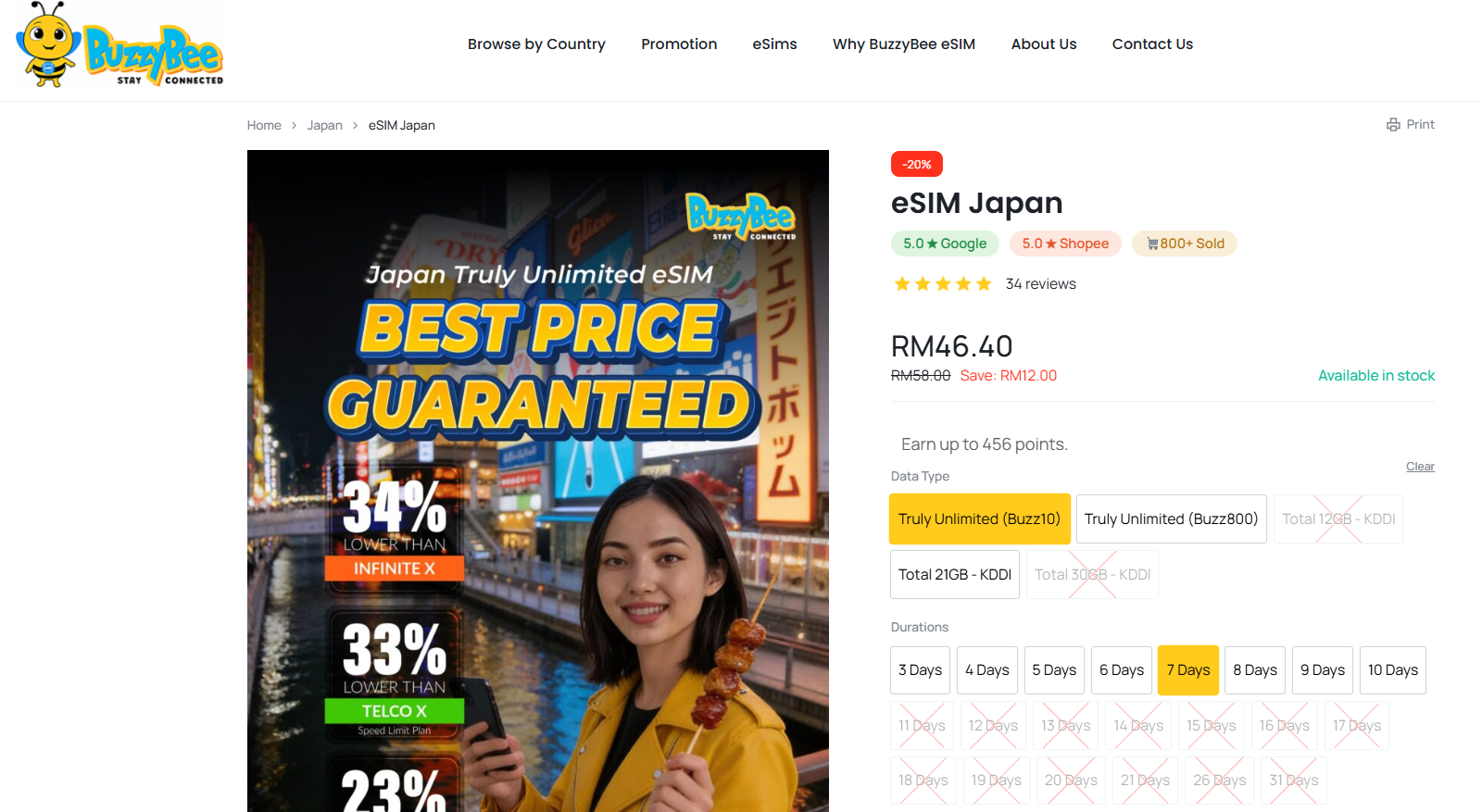
BuzzyBee is the strongest fit for Malaysians who want a local buying experience and for any traveller who wants KDDI/au data with unlimited options.
The Japan product page lists two truly unlimited options: Buzz800 and Buzz10. Buzz800 is positioned with 800 Mbps speed and Buzz10 with 10 Mbps speed. Both are listed as KDDI plans with no hidden limits, no speed reductions and no daily data cap. Fixed-data choices are also listed: Total 12GB, Total 21GB and Total 30GB.
BuzzyBee also supports hotspot on Japan Buzz800 and Buzz10 plans, with quota scaling by plan duration. Examples include 7 days with 6GB hotspot quota, 10 days with 9GB, 14 days with 13GB, 21 days with 20GB and 31 days with 30GB.
Klook Japan eSIM

Klook is a good option for travellers who already use Klook to book hotels, tickets and activities.
The old comparison placed Klook at RM60.59 for a 7-day Japan plan using Docomo 4G. Its main strength is convenience, especially if you already use Klook for Japan attractions, transport passes or hotel bookings.
For Klook unlimited plans, the high-speed allowance is 10GB per day without a speed limit. After the daily 10GB limit is used, speed is reduced to 128 kbps until the next daily reset. This is still usable for basic messaging, but it may feel slow for maps, video, uploads, hotspot use or social media browsing.
Saily Japan eSIM

Saily is a modern eSIM service designed for travellers who want fast and simple mobile data without using a physical SIM card.
It offers easy QR activation through its app and works across multiple destinations, making it a flexible option for international travel.
Saily provides different data plans depending on duration and usage needs, making it suitable for both short trips and longer stays in Japan.
Saily offers straightforward country and regional plans, making it a convenient option for short-term travel connectivity in Japan and other destinations.
Maxis Japan roaming
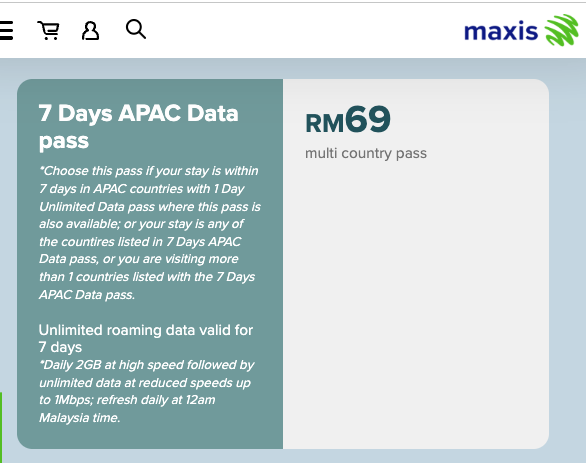
Maxis roaming is best for Malaysians who want to keep everything under their existing telco provider.
The old comparison included Maxis at RM69 for 7 days, with limited “unlimited” data under fair usage rules. This can be convenient for business travellers or people who do not want to install an eSIM, but Japan-specific eSIMs often give better value if you only need mobile data.
Ubigi Japan eSIM

Ubigi is best for frequent travellers who like app-based eSIM management and global coverage.
The old comparison listed Ubigi at RM97.57 for a 7-day Japan plan. Its strength is the app experience and support for multiple destinations. It may be less attractive for Malaysians who want Ringgit pricing and local WhatsApp-style support.
Holafly Japan eSIM

Holafly is best for travellers who prefer a well-known international eSIM brand with simple plan selection.
The old comparison listed Holafly at RM123.59 for 7 days. It can suit travellers who want a premium international brand, but Malaysian travellers should compare price, hotspot rules and fair usage details before choosing it over a local RM-priced option.
6. Best Japan eSIM by traveller type
The best Japan eSIM changes by traveller type, so comparing use cases is more helpful than naming one winner for everyone.
| Traveller type | Best-fit option | Why it fits |
|---|---|---|
| Best for Malaysians | BuzzyBee | RM pricing, Malaysia-based support, KDDI/au Japan plans and QR code activation. |
| Best for anyone visiting Japan | BuzzyBee, Klook, Ubigi or Holafly depending on usage | BuzzyBee for unlimited/hotspot, Klook for platform convenience, Ubigi for app users, Holafly for international brand simplicity. |
| Best for families | BuzzyBee Buzz800 or Buzz10 | Hotspot is supported, so one user can share data with a tablet or laptop within the hotspot quota. |
| Best for long stays | BuzzyBee 21-day, 26-day or 31-day options | BuzzyBee Japan offers durations up to 31 days and fixed-data choices up to Total 30GB. |
| Best for heavy data users | BuzzyBee Buzz800 | Buzz800 is positioned as truly unlimited on KDDI with 800 Mbps speed stated on the product page. |
| Best for budget travellers | Klook | Can be cheaper or familiar, but you must check seller terms, network, FUP and support. |
| Best for business travellers | BuzzyBee or Maxis | BuzzyBee is better for data value; Maxis is convenient if you want telco billing and familiar roaming. |
| Best for content creators | BuzzyBee Buzz800 | Better suited for uploads, video calls, social posting and map-heavy travel than capped low-data plans. |
Ready to Stay Connected in Japan?
Choose a BuzzyBee Japan eSIM before you fly. Install on Wi-Fi, land in Japan, turn on data roaming and start using mobile data without queuing for a SIM card.
Get BuzzyBee Japan eSIM →7. Network, speed and fair usage policy
Network and fair usage policy matter because two plans can both say “unlimited” but perform very differently in real travel use.
KDDI/au, NTT Docomo, SoftBank and Rakuten are major network names travellers may see in Japan eSIM listings. A provider’s network affects speed, coverage and reliability, but the plan’s fair usage policy is just as important.
A fair usage policy, or FUP, is a rule that slows your data speed after you use a set amount of high-speed data. For example, a plan may advertise unlimited data but reduce speed after 2GB, 3GB or a larger total allowance. This is why heavy users should read the plan details carefully before buying.

BuzzyBee’s Japan Buzz10 and Buzz800 product positioning states no hidden limits, no speed reductions and no daily data cap. This is the key reason BuzzyBee is better suited for heavy users, families sharing hotspot and travellers who do not want to keep checking data usage.
8. eSIM vs roaming, pocket WiFi and physical SIM
An eSIM is usually the easiest Japan internet option for travellers who have an eSIM-compatible phone.
Roaming is convenient because it stays under your Malaysian telco, but it can cost more for Japan-only trips and may include fair usage limits. Pocket WiFi can work for families, but it adds another device to charge, collect and return. A physical SIM may be cheaper in some cases, but you need to swap SIM cards and may need to queue at the airport or shop.
| Option | Pros | Cons |
|---|---|---|
| eSIM | Buy before travel, QR activation, no physical SIM swap, keep Malaysian SIM active. | Phone must support eSIM and QR code can usually be scanned once. |
| Malaysian telco roaming | Easy for existing telco users, no new SIM setup. | Can be more expensive and may include fair usage limits. |
| Pocket WiFi | Can share with several devices. | Extra device to charge, carry, collect and return. |
| Physical SIM | Works on phones without eSIM support. | Requires SIM swap and may involve airport queues. |
9. How to install your Japan eSIM
You should install your Japan eSIM while connected to Wi-Fi before your flight, then turn on mobile data and roaming after landing in Japan.
- Check that your phone supports eSIM before buying.
- Buy your Japan eSIM from BuzzyBee or your chosen provider.
- Open the QR code email on another device or print it if needed.
- Go to your phone’s mobile data settings and add a new eSIM.
- Scan the QR code and complete installation while on Wi-Fi.
- When you arrive in Japan, select the eSIM for mobile data.
- Turn on data roaming for the eSIM line.
- Keep your Malaysian SIM active if you need OTP or banking SMS.
Important BuzzyBee Japan note
The Japan product page states that the QR code can only be scanned once. Install it carefully, do not delete it after installation, and check your phone compatibility before purchase.
10. Verdict: which Japan eSIM should you choose?
Choose BuzzyBee if you are Malaysian and want a Japan eSIM with RM pricing, Malaysian support, KDDI/au access, unlimited options and hotspot support.
Choose Klook if you already book most of your Japan travel through Klook and want a familiar platform. Choose Maxis roaming if you want the simplest telco route and do not mind the cost. Choose Ubigi if you like app-based global eSIM management. Choose Holafly if you prefer an international unlimited-style plan and accept a higher price.
For most Malaysian travellers who want value, support and a direct Japan eSIM plan, BuzzyBee is the strongest all-round choice. For anyone outside Malaysia, BuzzyBee still makes sense if the KDDI/au network, unlimited data positioning and hotspot support match your trip needs.
Skip the SIM Card Queue at the Airport
Get your Japan eSIM before departure and connect when you land in Tokyo, Osaka, Sapporo, Fukuoka or anywhere with supported coverage.
Browse Japan Plans →Frequently Asked Questions
What is an eSIM and how does it work?
An eSIM is a digital SIM built into supported phones. Instead of inserting a physical SIM card, you scan a QR code to install a mobile data plan. For Japan travel, this lets you buy data before flying and connect after arrival without visiting a SIM counter.
Will my phone work with a BuzzyBee Japan eSIM?
Your phone must support eSIM and must not be locked to another carrier. Many newer iPhone, Samsung Galaxy and Google Pixel models support eSIM, but you should check before buying. BuzzyBee also provides a supported-device page to help travellers confirm compatibility.
Which Japan network does BuzzyBee use?
BuzzyBee Japan uses KDDI/au for its verified Japan eSIM plans. The product page lists KDDI for Buzz10, Buzz800 and fixed total-data options. Network performance can still depend on your device, location, building conditions and local network availability.
Is BuzzyBee best for Malaysians visiting Japan?
BuzzyBee is a strong choice for Malaysians because it offers local RM pricing, a Malaysia-based brand experience, WhatsApp-style support and Japan eSIM plans powered by KDDI/au. It is especially useful for travellers who want to avoid airport SIM queues and foreign-currency checkout confusion.
Is BuzzyBee also suitable for non-Malaysian travellers?
Yes. Non-Malaysian travellers can still consider BuzzyBee if they want a Japan eSIM with KDDI/au access, QR activation, unlimited options and hotspot support. The Malaysian angle is a benefit for local buyers, but the plan features can also suit travellers from other countries.
What is the best Japan eSIM for families?
Families should look for hotspot support, enough data and a clear fair usage policy. BuzzyBee Buzz10 and Buzz800 support hotspot with quotas that scale by duration, which can help when sharing data with a tablet or laptop. For several heavy phone users, buying separate eSIMs may still be better.
What is the best Japan eSIM for long stays?
Long-stay travellers should choose a provider with longer validity options and enough data for the whole trip. BuzzyBee Japan lists durations up to 31 days and data types including truly unlimited options plus Total 12GB, Total 21GB and Total 30GB plans.
When does my BuzzyBee Japan eSIM validity start?
BuzzyBee’s Japan validity rule says each day is counted from 12:00 AM to 12:00 AM Japan local time upon activation. Install the eSIM before travel using Wi-Fi, then activate mobile data after arriving in Japan so you do not waste your plan before departure.