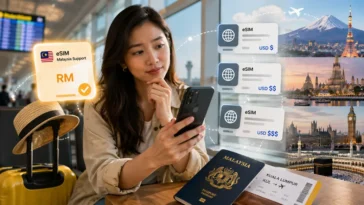
Hatyai eSIM vs Roaming: Which Is Better for Malaysians?
Going to Hatyai for a quick 3–5 day trip? Here is what actually matters before paying for roaming or choosing a Thailand eSIM.

You cross the Thai border, open Google Maps to find your hotel...
...and suddenly realise your phone has no data.
Not ideal when your hotel address is in WhatsApp, the family is asking where to eat, and someone already wants to book a Grab.
For a short Hatyai trip, the internet decision looks simple: just switch on roaming.
But a 3-day trip can give you several very different choices: Malaysian telco roaming, a normal Thailand travel eSIM, or a Thailand local eSIM using networks such as TrueMove H or DTAC.
And surprisingly, roaming is not automatically the expensive option anymore.
So instead of asking, “Which one is cheapest?”, the better question is: what are you actually getting for the money?
In This Article
- Hatyai eSIM vs Roaming: What Actually Changes?
- How Much Does a Hatyai eSIM or Roaming Pass Cost?
- Thailand Local eSIM vs Travel eSIM
- How Much Hatyai eSIM Data Do You Actually Need?
- Driving to Hatyai? Do Not Scan the Local eSIM Before Entering Thailand
- When Roaming Is Actually the Better Hatyai Option
- When a Hatyai eSIM Makes More Sense
- Which Hatyai eSIM or Roaming Option Should You Choose?
- Frequently Asked Questions
1. Hatyai eSIM vs Roaming: What Actually Changes?
The main difference is simple: roaming keeps your Malaysian telco handling the connection, while an eSIM gives your phone a separate travel data line.
For a Hatyai (Hat Yai) weekend, both can work perfectly well.
The better choice depends on what you value more: convenience, data amount, local-network access or price.
| Option | Why Choose It? | Main Catch |
|---|---|---|
| Malaysian Telco Roaming | Keep using your existing SIM and number with minimal setup | Price, high-speed quota and eligibility depend on your telco and plan |
| Thailand Travel eSIM | More choice between daily data, total data and higher-data plans | Data-only, requires an eSIM-compatible phone, and does not work in Pattani, Narathiwat or Yala |
| Thailand Local eSIM | Uses a Thailand local-network option such as TrueMove H or DTAC | BuzzyBee's local version must only be scanned after entering Thailand |
| Thai Physical SIM | Useful if you specifically want a physical local SIM | Requires SIM purchase, registration and SIM swapping depending on the product |
This is why saying “eSIM is always cheaper than roaming” is too simplistic.
Sometimes it is.
Sometimes your telco already has a pretty reasonable ASEAN pass.
And if your current Malaysian plan already includes Thailand roaming, buying another eSIM could actually be unnecessary.
Check Your Existing Plan Before Buying Anything
Some Malaysian postpaid plans or add-ons already include roaming in Thailand. Open your telco app first. If you already have enough included data, the cheapest Hatyai eSIM may actually be no eSIM at all.
2. How Much Does a Hatyai eSIM or Roaming Pass Cost?
For short Hatyai trips, entry prices currently range from around RM12 for an eSIM to RM28–RM48 for common 3-day Malaysian telco roaming passes.
But price alone does not tell you how much high-speed data you are getting.
As of October 2026, here are some useful reference points:
| Option | Current Price | What You Get | Good For |
|---|---|---|---|
| BuzzyBee Thailand Travel eSIM | From RM12.40 | Daily 1GB, 2GB or 3GB plans, Truly Unlimited (Buzz10), or total data from 3GB to 30GB | Travellers who want more flexibility |
| BuzzyBee Thailand Local eSIM | From RM17.80 | Total data from 3GB up to 50GB on TrueMove H or DTAC, 3 to 30 days | Travellers who want a Thailand local-network option |
| CelcomDigi 3-Day Pass | RM28 | 4GB high-speed data plus 15 minutes of voice calls, valid in Singapore, Indonesia and Thailand | CelcomDigi prepaid or postpaid users who want simple roaming |
| CelcomDigi 3-Day Unlimited Pass | RM48 | 2GB high-speed data daily, then unlimited at up to 1Mbps, plus 15 minutes of voice calls | CelcomDigi users who need more than 4GB |
| Maxis 3-Day ASEAN Pass | RM39 | 2GB high-speed data daily, then unlimited at reduced speed (1Mbps); data only, no calls or SMS | Maxis Postpaid users only |
Prices and plan terms can change, so always check the latest checkout price before travelling.
Notice something interesting?
CelcomDigi's RM28 pass is already quite competitive for a three-day Hatyai trip.
So if you are a CelcomDigi user who only needs 4GB, buying an eSIM just to save a few Ringgit may not be worth the extra setup.
Maxis Postpaid users get more high-speed data per day for RM39, but the pass is not available on Hotlink prepaid.
On the other hand, if 4GB is nowhere near enough for your TikTok, Instagram, YouTube, hotspot and Google Maps habits, then comparing eSIM data plans becomes much more interesting.
You can check the latest official roaming terms directly from CelcomDigi roaming and Maxis roaming.
3. Thailand Local eSIM vs Travel eSIM: What's the Difference?
A Thailand local eSIM gives you a specific Thailand local-network option, while a normal travel eSIM is designed mainly to give travellers convenient mobile data coverage.
BuzzyBee currently offers both.
Option 1: BuzzyBee Thailand Local eSIM
The BuzzyBee Thailand Local eSIM currently offers TrueMove H and DTAC network options.
Available total-data choices include 3GB, 5GB, 10GB, 15GB and 50GB depending on the selected network and duration, with plans ranging from 3 to 30 days.
Both are data-only eSIMs with 4G/5G connectivity where available, and no registration is required.
TrueMove H or DTAC?
For most Hatyai tourists, you do not need to overthink this.
BuzzyBee lists both TrueMove H and DTAC as suitable Thailand local-network choices for maps, WhatsApp, LINE, Grab, browsing and social media.
The DTAC option is particularly relevant if you specifically require a Thailand local IP.
If you have no idea what “local IP” means, you probably do not need to choose your plan based on it.
Where the Thailand Local eSIM Becomes Interesting
If your trip is focused entirely on Thailand and you specifically prefer a local-network option, BuzzyBee lets you choose TrueMove H or DTAC instead of simply buying a generic travel data plan. Prices are shown in RM, there is no physical SIM to collect, and the QR code is delivered by email.
Option 2: BuzzyBee Standard Thailand eSIM
The normal BuzzyBee Thailand eSIM gives you more ways to structure your data.
Current choices include:
- Lite: 1GB per day
- Ultra: 2GB per day
- Ultra Max: 3GB per day
- Truly Unlimited (Buzz10): the highest-data option for heavy users
- Total Data: 3GB, 5GB, 10GB, 20GB or 30GB options
This can make more sense if you are mainly comparing how much data you need rather than which Thai network you want.
Local eSIM Does Not Mean You Get a Thai Phone Number
BuzzyBee's Thailand Local eSIM is data-only. It does not include a Thai phone number, normal calls, SMS or top-up. For calls, use internet apps such as WhatsApp, LINE, FaceTime Audio, WeChat or Telegram.
4. How Much Hatyai eSIM Data Do You Actually Need?
For most 3–5 day Hatyai trips, the right amount depends much more on your phone habits than the length of the trip.
If you mostly use Google Maps, WhatsApp, LINE, Grab and occasional browsing, you do not need a giant 50GB plan just because it sounds better.
Here is a practical guide:
| Traveller Type | Suggested Data | Typical Usage |
|---|---|---|
| Light User | Around 3GB total | Maps, WhatsApp, LINE, Grab, basic browsing |
| Normal Traveller | Around 5–10GB total | Maps, messaging, social media, photos and some video |
| Heavy User | 15GB+ or a higher daily-data plan | Frequent video, reels, uploads, hotspot or work |
| Family Hotspot User | Choose a larger plan | Sharing one phone's connection with several devices |
These are rough usage guidelines, not fixed rules.
That last category is where people often underestimate their usage.
One person using Google Maps is nothing.
One person sharing hotspot with a spouse and two children watching videos?
Different story.
Daily data or total data?
A daily plan is useful if you want a fresh allowance every day.
A total-data plan is more flexible if your usage changes from day to day.
For example, maybe Day 1 is just driving, checking into the hotel and eating.
Then Day 2 somehow becomes six hours of maps, TikTok, café photos, night-market videos and searching “best dim sum Hatyai”.
A total-data pool lets you use more on the busy day and less on the quiet one.
One small detail: on BuzzyBee's standard Thailand eSIM, each day is counted on Malaysia time (midnight UTC+8), which is 11pm in Thailand.
5. Driving to Hatyai? Do Not Scan the Local eSIM Before Entering Thailand
This is probably the most important thing in this entire article.
If you buy the BuzzyBee Thailand Local eSIM, do not scan and activate the QR code while you are still in Malaysia.
The current product instructions specifically state that scanning the local eSIM outside Thailand may wipe the data.
Day 1 also starts as soon as the eSIM is installed.
Cross the Border First. Scan the QR Code Second.
Buy the plan before your trip and keep the QR code ready, but only scan it after you have entered Thailand. An internet connection is required during installation, so make sure you have Wi-Fi, a companion's hotspot or another temporary connection available when setting it up.
This matters more for Hatyai travellers than Bangkok travellers because many Malaysians enter southern Thailand by car, van or train instead of landing at an airport with easy Wi-Fi.
So plan your activation point before the trip.
Five minutes of preparation is better than standing after immigration wondering how to get online.
Entering via Rantau Panjang? Note the Travel eSIM Coverage Gap
BuzzyBee's standard Thailand Travel eSIM does not work in Pattani, Narathiwat or Yala, where local operators do not allow roaming. Hatyai itself is in Songkhla, and the Bukit Kayu Hitam–Sadao and Padang Besar crossings lead straight into Songkhla. But if you cross at Rantau Panjang–Sungai Kolok, the first part of your drive is through Narathiwat, so you will not have travel eSIM data until you reach Songkhla.
6. When Roaming Is Actually the Better Hatyai Option
Roaming is the better choice when convenience matters more than getting the largest possible data allowance for your money.
There is nothing wrong with paying a little more to remove one more thing from your travel checklist.
Choose roaming if:
- Your Malaysian plan already includes Thailand roaming.
- Your telco offers enough data for your trip at a reasonable price.
- You want to keep everything on one SIM.
- You do not want to install another eSIM.
- Your phone does not support eSIM.
- You only use a small amount of data during a short trip.
CelcomDigi is a good example.
At RM28 for its current three-day Singapore, Indonesia and Thailand pass, a CelcomDigi customer going to Hatyai for one weekend may reasonably decide:
“RM28 only? Never mind lah, just roam.”
And that is a perfectly sensible decision.
The point of comparing options is not to force everyone into an eSIM.
It is to avoid paying for something you do not need.
7. When a Hatyai eSIM Makes More Sense
A Hatyai eSIM becomes more attractive when you want more control over your data amount, duration or network choice.
Choose an eSIM if:
- You need more data than your roaming pass provides.
- Your trip length does not match your telco's 3-day or 7-day passes.
- You prefer a fixed total-data pool.
- You want higher daily-data options.
- You specifically want a Thailand local-network option.
- Your prepaid plan has no suitable roaming pass.
- You want to keep your Malaysian SIM separate for calls or OTP SMS while using another line for travel data.
This last setup is especially useful for Malaysians.
On compatible dual-SIM phones, you can keep your Malaysian line active while selecting the travel eSIM as the mobile-data line.
Just turn off data roaming on your Malaysian SIM so your phone does not accidentally use the wrong line for overseas data.
8. Which Hatyai eSIM or Roaming Option Should You Choose?
There is no single winner for every Hatyai traveller.
Choose Malaysian telco roaming if your existing plan already includes Thailand, or if a RM28–RM48 short-trip roaming pass gives you enough data and you value convenience.
Choose a standard Thailand travel eSIM if you want more flexibility between daily allowances, total-data plans and heavier data usage, and you are not relying on it in Pattani, Narathiwat or Yala.
Choose a Thailand local eSIM if you specifically prefer a TrueMove H or DTAC local-network option and your trip is focused on Thailand.
Choose BuzzyBee if you want to compare Thailand plans in RM, choose between standard travel and local-network eSIM options, and receive the plan digitally without collecting a physical SIM.
But remember the trade-off: the local eSIM is data-only, and you must only scan it after entering Thailand.
For a Hatyai trip, compare the plan first. Compare the logo second.
Compare Your Hatyai Data Options Before You Cross the Border
Choose from Thailand local eSIM options using TrueMove H or DTAC, with different data amounts and durations depending on how you actually use your phone.
See Thailand Local eSIM Options →Frequently Asked Questions About Hatyai eSIM
What is the best Hatyai eSIM for Malaysians?
The best Hatyai eSIM depends on how much data you need and whether you prefer a normal travel eSIM or a Thailand local-network option. BuzzyBee currently offers both standard Thailand eSIM plans and local eSIM options using TrueMove H or DTAC.
Is a Hatyai eSIM cheaper than roaming?
It can be, but not always. BuzzyBee Thailand eSIM plans start from RM12.40, while CelcomDigi's 3-day Singapore, Indonesia and Thailand pass is RM28 for 4GB and the Maxis Postpaid 3-day ASEAN pass is RM39. Compare the high-speed data allowance as well as the price.
Can I activate my Thailand Local eSIM before crossing into Thailand?
No. For BuzzyBee's Thailand Local eSIM, only scan the QR code after you have entered Thailand. The current product instructions warn that scanning it outside Thailand may wipe the data.
Does the Thailand Local eSIM come with a Thai phone number?
No. BuzzyBee's Thailand Local eSIM is data-only and does not include a phone number, normal calls, SMS or top-up. Internet calling apps such as WhatsApp and LINE can still be used.
Can I keep my Malaysian SIM active for banking OTPs?
Usually yes if your phone supports dual SIM or dual-profile operation. Keep your Malaysian SIM active for calls and SMS, then select the Thailand eSIM for mobile data. Check your Malaysian telco's roaming charges for any calls or SMS usage.
Does a Hatyai eSIM support hotspot sharing?
BuzzyBee's Thailand Local eSIM generally supports hotspot sharing, although availability can vary by device and network. If you plan to share data with several family members, choose a larger data plan.
Should I choose TrueMove H or DTAC for Hatyai?
Both are offered as Thailand local-network options suitable for normal travel usage. Choose based on your preferred plan, data amount and price. BuzzyBee specifically recommends the DTAC Local IP option if you require Thailand local IP access.
Does the Thailand eSIM work if I enter through Sungai Kolok?
BuzzyBee's standard Thailand Travel eSIM does not work in Pattani, Narathiwat or Yala. Sungai Kolok is in Narathiwat, so expect no travel eSIM data until you reach Songkhla province, where Hatyai is located.
How much data do I need for a 3-day Hatyai trip?
Around 3GB may be enough for light use such as maps and messaging, while 5–10GB gives more room for social media and video. Heavy users, hotspot users and families should consider larger data plans or higher daily allowances.
Hatyai eSIM vs Roaming: What Malaysians Should Pick
A practical comparison for Malaysians crossing the border for a Hatyai weekend.
In This Article
- 1. Hatyai eSIM vs roaming: what changes?
- 2. Compare the Hatyai plan, not just the price
- 3. Thailand Local eSIM vs travel eSIM
- 4. When should you activate a Thailand eSIM?
- 5. When roaming is the better Hatyai option
- 6. When a Hatyai eSIM makes more sense
- 7. Which Hatyai option should you choose?
- Frequently Asked Questions About Hatyai eSIMs
1. Hatyai eSIM vs roaming: what changes?
Roaming keeps your Malaysian SIM handling mobile data in Thailand. An eSIM gives your phone a separate travel-data line.| Option | Choose it if | Check first |
|---|---|---|
| Malaysian roaming | You want the simplest setup | Thailand coverage, quota, validity and FUP |
| Thailand travel eSIM | You want a separate data line | Data type, validity and phone compatibility |
| Thailand Local eSIM | You want a local-network option | Activation timing and product instructions |